Field-Tested Hands-On Learning Vs AI Hegemony in Education
4 minute read
Yesterday, New York City announced a sweeping AI ban for young students.
While the debate over the future use of AI in schools will continue amidst the new moratorium, we’re using this moment to focus on how established hands-on learning approaches are enriching the lives of students while getting them away from screens and the allure of the newest ‘must have’ AI-assisted education apps.
The moratorium has garnered support from educators and unions, many of whom campaigned for the new measures. Randi Weingarten, president of the American Federation of Teachers, said: “This is very similar to what the AFT proposed in May,” later adding on Bluesky: “Older students need to be digitally ready and carefully taught the tool of AI but younger students need to learn to think — that requires less screens and less cognitive offloading.”
As a first step, this moratorium appears to connect with and address deeply held public concerns around the role of AI in education. The prevailing sense of inevitability regarding the profusion of AI technologies into all aspects of our lives has been stymied, if for a moment. Let us grab that moment to pause and reflect. From our side, how can the upscaling of field-tested pedagogies like hands-on, project-based learning offer an alternative to the ever-enticing yet risky and expensive streamlining of AI into all areas of education?
The hands-on learning offered by NY Sun Works provides everything that AI currently does not: empathy, mindfulness and a sense of agency.
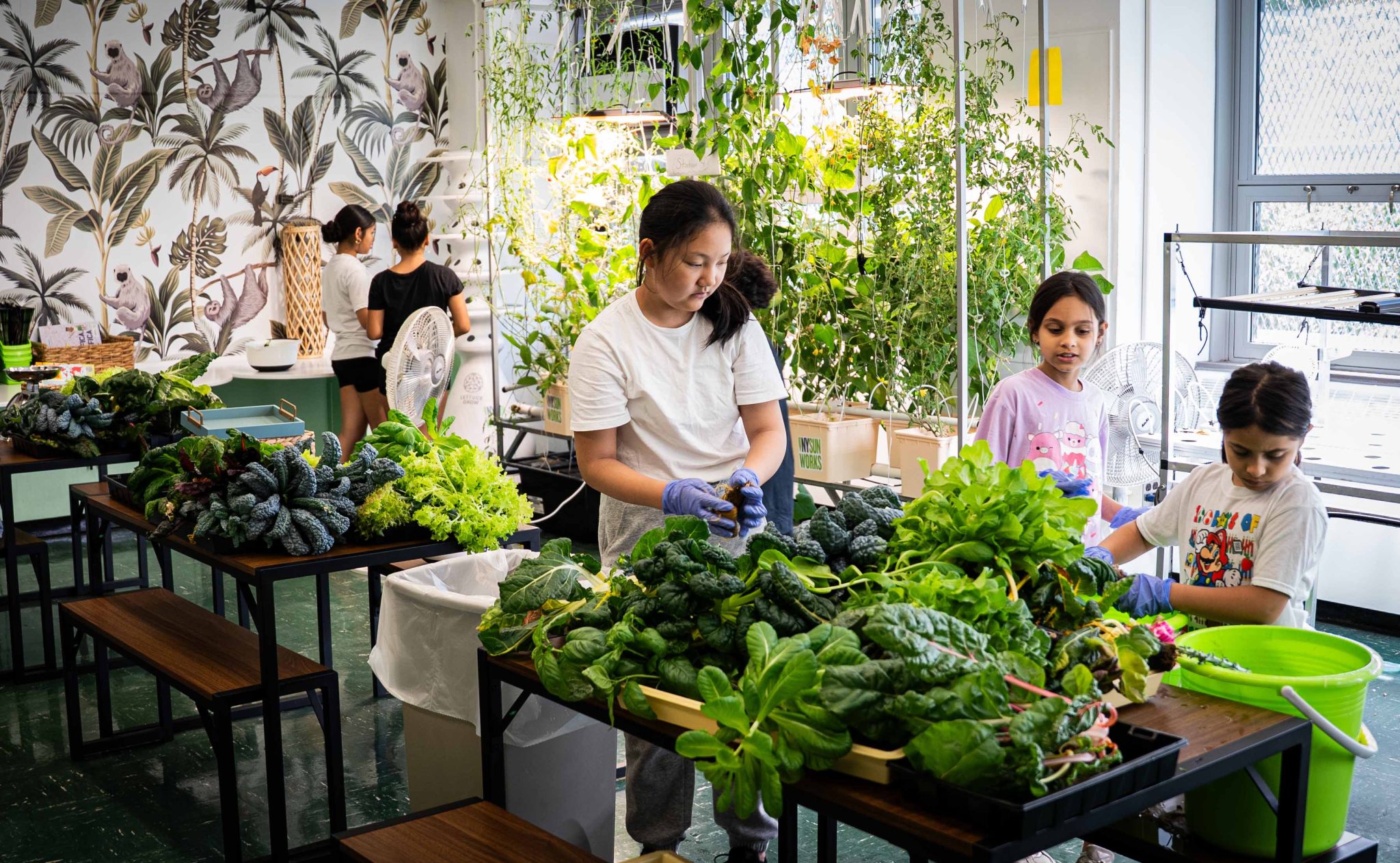
Students at the George H. Lindsay School in Brooklyn harvest their hydroponic systems.
Away from all the drama around AI, teachers across NYC have been quietly and in increasing numbers adopting proven hands-on learning pedagogies. Chief among these is the NY Sun Works model: In over 400 schools, NY Sun Works Hydroponic Classrooms offer students an entirely different vision of what it is to be a student. This research-backed pedagogy fosters human connection and gives students the chance to develop crucial social skills: the empathy, mindfulness and sense of agency that lead to more positive mental health outcomes. In short, Hydroponic Classrooms and their associated curricula are the healthy slow food equivalent to AI’s processed fast food (and it is MUCH better for the environment).
We spoke to students at Thomas A. Edison Career and Technical Education High School in Queens to get their thoughts on the benefits of a Hands-On pedagogy vs AI: “(Being in the Hydroponic Classroom) is very calming,” said Kiani. “I was so curious about everything. I don’t use AI at all because I’m an artist and a writer and generative AI can negatively affect those spaces, so I don’t use it. In the Hydroponic Classroom it’s very hands-on, you are interacting with life and connecting to nature. We’ve been doing a lot of team work in the mornings like cleaning up and getting the systems ready.”
Another student named Nalayh said: “It’s more hands-on and better than other classes. There is more movement and helpful energy. There is more teamwork – we work together as a team to fix problems.”
Recent research by Dr. Alex Kudryavtsev published in The Journal of Environmental Education underlines these students’ experiences, showing how our model of sustainability science education enables student-centered, team-based learning. This emphasis on the development of team-working, empathy and mindfulness presents a distinct alternative to the AI philosophy of education: AI excels in systems that measure student progress quantitatively via their capacity to achieve standardized individual learning outcomes, i.e. score highly in standardized tests or hit upon the desired number of major themes within an essay response. It can provide the “correct” answer to a student without the need for the student to think through and develop their own thoughts on a topic, thus, according to the American Federation of Teachers, AI use can “weaken a student’s cognitive development.” Our model by comparison gets students off screens, learning actively in a way that improves their well-being. They get to see how the knowledge they apply has an effect upon the physical world in real time AND they get to share the fruits of their research (a variety of fresh produce) with their family and community.
No one summarizes our impact better than our partner teachers, as you can see from a response to our annual teacher survey: “This year, our Hydroponic Classroom evolved into much more than a traditional growing space. It became a multidisciplinary STEM hub that connected biology, sustainability, nutrition, wellness, entrepreneurship, and community engagement. Students participated not only in growing food, but also in designing outreach initiatives, producing value-added products, exploring food access/community wellness concepts, and leading public-facing educational activities. One of the biggest successes was seeing students take ownership of authentic projects with visible real-world impact. The systems and curriculum provided by NY Sun Works created an excellent foundation for this type of hands-on learning. Overall, the Hydroponic Classroom continues to be one of the most engaging and impactful educational environments in our school.”
To conclude, as our representatives work to get the balance right in harnessing the benefits of AI technology while mitigating the harms, we should not lose sight of the proven models that are already inspiring students to become passionate about STEM and the joy that comes from the pursuit of knowledge for its own sake.
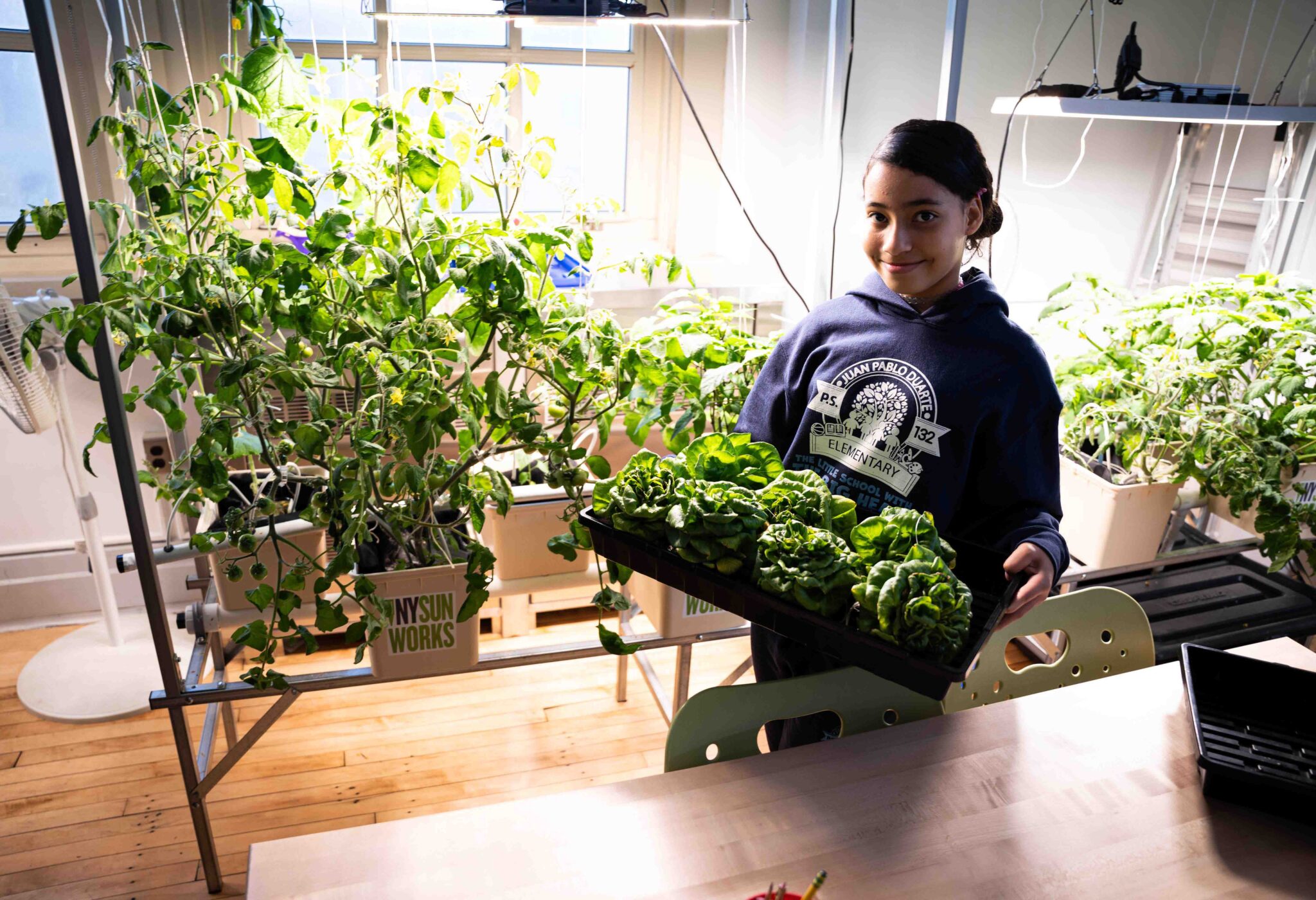
A student at the Juan Pablo Duarte Elementary School in Manhattan holds a tray of recently-harvested lettuce.
BACKGROUND: How did AI policy in NYC schools shift over the summer?
According to a recent report by the Pew Research Center, over half of all teens in the US use AI chatbots for help with their homework. It is a sobering figure that demonstrates the level of reliance students now have on what was essentially an unregulated emerging technology. Like the arrival of the internet, AI represents a major historical rupture in education. In our city right now, a lively (and necessary) debate is underway as to how we should respond to this rupture.
To begin, how do you start to create guidelines for something that never assumes a fixed shape? The answer, as we have learned over the last months, is “with great difficulty.”In July 2026, The Gothamist highlighted the new limbo in software procurement implemented across the nation’s largest school system, as NYC Public Schools Chancellor Kamar Samuels ordered a pause on further contracts for AI services in response to the growing public backlash against the emerging AI policy. This year, over half of NYC’s City Council members signed a letter requesting that the Major pause AI use in schools, citing concerns about learning and mental health. The latest research from the Brookings Institution supports such skepticism, asserting that “given the current trajectory of generative artificial intelligence and its implementation and use, the potential risks to students overshadow the benefits.”
Inevitably, in the former absence of an AI policy, individual schools across NYC began developing wildly different approaches and policies to AI use, leading to thousands of parents calling for a moratorium. During the PEP meeting, concerned members of the public highlighted the fact that many technologies are already in use that contradict the initial AI policy released in March 2026 (and subsequently withdrawn), such as digital bathroom hall pass technology in use in over 150 schools in NYC. As noted in the New Yorker, such scenarios were the inevitable result of the mismatch between the speed of institutional response and the slower-to-solve questions faculty and administration are facing in schools when faced with specific cases of AI use. In short, our policy makers were trying to respond to AI quickly, but faculty and administration were the ones dealing with the hardest implementation questions without an official policy to provide clarity.
Thankfully, our policy makers woke up to the fact that the situation had become untenable and a moratorium is now in place. Following the decision to pause procurement, the Chancellor Kamar Samuels has promised to release updated AI guidelines at a later date.