TESTING donation page
Announcing the Partner Teacher Community Carnival!
On October 18th, NY Sun Works is excited to invite partner teachers from around NYC to join us for our first-ever Teacher Community Carnival! Hosted at Project Farmhouse in Union Square from 4:30 to 7:30 PM, come as our guest and enjoy food, beverages, and themed carnival games as we announce the official launch of our online Teacher Community on Circle. We’ll also shout out the teachers who received our NY Sun Works Educator Certification, and celebrate the successful start of another amazing school year.
As our partner teachers continue cultivating both classroom crops and the farmer-scientists who grow them, we also want to foster a sense of community, personal growth, and positive engagement for the in-school educators who make our work possible. Over the coming months, NY Sun Works affiliated teachers can expect at least one opportunity each month to connect with others teaching in our program, either virtually or in person, through professional development opportunities, constructive workshops, and casual teacher connectivity events.
Every teacher in our program goes above and beyond for the sake of the students in their classroom, adding urban farming skill sets to their already extensive teaching tool repertoire. We want to honor the hard work, personal sacrifice, and genuine passion partner teachers have brought to our program by providing spaces for teachers to share stories, tips and tricks, and advice with peers who run hydroponic classrooms of their own. Our online Teacher Community will allow educators to participate in discussions that transcend not only their school, but grade level, borough, and pedagogical approach.
Partner teachers interested in RSVP’ing should check their email inbox for further information and a registration link. We hope to see you there!
Blah
NY Sun Works Welcomes New Board Member Uche Amaechi
In the wake of Climate Week NYC, we’re honored to welcome Dr. Uche B Amaechi to the NY Sun Works Board of Directors. Uche brings extensive experience working with nonprofits in the world of education and has an Ed.D. from the Harvard Graduate School of Education in Cultures, Community, and Education, as well as an Ed.M. from the Harvard Graduate School of Education in Technology, Innovation, and Education, an MBA from the University of Phoenix online, and a BA in Biology from Harvard College. Uche currently serves as a Lecturer on Education at the Harvard Graduate School of Education (HGSE), with a focus on helping education-focused nonprofits effectively scale for impact. Beyond Harvard, he also works in the Cambridge Public Schools on school leadership, collaboration, and previously served for eight years in roles directing out-of-school programming in Cambridge.
“I’m inspired by NY Sun Works’ commitment to providing high-quality education where it’s most needed, in service of inspiring future generations of innovators to create and contribute to solutions to our global climate challenges.” Said Uche about joining the NY Sun Works Board. “I’m excited to join the capable and passionate team, board, and staff members in furthering this most important and urgent work.”
By incorporating Uche’s expertise in the world of education nonprofits into our Board of Directors, we hope to effectively and sustainably scale our organization to meet the needs of our growing community and to bring climate change education to more students at a pace that is commensurate with the need. With over 100 new Hydroponic Classrooms in schools this year alone, it’s critical that we continue delivering the in-depth and comprehensive support a program like ours needs to thrive. As a mission-focused organization, our work is naturally resource-limited, making the effective use and application of our resources tantamount to achieving our mission. We envision a world where every New York City public school – and beyond – includes opportunities for students to learn about the health of our planet and their role in preserving it in a way that captures their attention, forms long-term habits, and builds the awareness necessary to create climate-conscious New Yorkers. Every child deserves a sustainable future, and Uche’s insights in this realm will be instrumental in making our vision a reality.
While serving on the board of Community Charter Schools of Cambridge, City Sprouts, and Farrington Nature Linc, Uche also worked to target low-income and minority populations, which aligns with our focus on working with underserved communities and schools. From Brooklyn to the Bronx, communities of color are often on the front lines of climate change, facing the effects first and most severely while being excluded from major environmental resiliency efforts. Making climate education happen for schools with profoundly limited opportunities isn’t an easy task, but now more than ever, we believe it is an achievable one. Only through intentional acts of transformative change can we solve the systemic inequity that has loomed over sustainability efforts and its educational awareness in recent years. Teachers and students have made their voices heard: The thirst for knowledge is there, and it’s up to us to imagine, build, and be the change we want – and need – to see in NYC and beyond.
Blah
The Importance of Climate Education, 365 Days a Year
This week is Climate Week NYC, one of the most significant occasions for New Yorkers looking to make a difference in the health and sustainability of our planet’s environment. Organized by the Climate Group, Climate Week offers sustainability advocates big and small an opportunity to join forces, drive climate action, and celebrate our victories while discussing challenges on the road ahead. This year, we kicked off Climate Week and back to school with a story by CBS News, covering our work in Brooklyn and the 60 new schools we’re adding to our community of farmer-scientists (bringing the total number of NY Sun Works hydroponic classrooms to over 300).
We’re thrilled to welcome these new partner schools to our program and the thousands of students who will now have the opportunity to explore the science behind climate change, and how their actions can shape the Earth’s future. But the need for this kind of education also highlights an important disconnect between young New Yorkers and the state of the natural world around us. Growing up in the concentrated concrete of NYC undoubtedly has a formative impact on students who spend the majority of their schooling years within the confines of the city. While there are numerous parks, gardens, and green public spaces that dot the landscape of the Big Apple, it should come as no surprise that students who may have never ventured beyond their borough have a tenuous connection at best with the health of our planet. This comes as no fault of their own of course, as many schools in historically underserved communities lack the resources to adequately provide students with a holistic climate science education while ensuring sufficient exposure to other subjects, and meeting their general logistical needs. These resource deficiencies also disproportionately impact Black and Brown communities, who have been left behind when it comes to mainstream climate resiliency efforts. We see this as a fundamental climate injustice, as low-income communities are typically where the impacts of climate change are felt first and most strongly. Through programs like ours, which build sustainability into existing educational foundations in neighborhoods like these, we hope not only students but their teachers, families, and friends will reap the rewards and foster a new sense of connectedness with the planet we call home.
To that end, our Executive Director Manuela Zamora joined Green Mentors at the 7th NYC Green Schools Conference, hosted by the Sustainable Development Solutions Network (SDSN) on Friday, September 15th as part of the United Nations 78th General Assembly (UNGA78). In collaboration with diplomats, educators, policymakers, and climate leaders, we shared our vision for the future of climate education, and learned from others how best to maximize the accessibility, compassion, and humanity of our shared goals. Sustainability is, by definition, an idea that spans a wide breadth of time, and naturally requires us to think long-term about our goals if we want to make lasting change. Climate education is a serious topic, and while we love discussing the beautiful plants and smiling faces that result from our hydroponic classrooms, we also want to emphasize the causal factors that have drawn us to build them. The young people of today are facing a unique challenge in the form of a climate-altered future, and it falls to us as leaders, elders, and residents of planet Earth to do our part in preparing them for it. Current climate action is of course equally necessary, but we also want to call attention to the future, and with the right level of intentional action, the bright possibilities that come with it.
This Climate Week has brought a host of celebratory occasions to the city, which we’re incredibly excited to share with you in the remainder of this week’s Newsletter. From the Prince of Wales to the President of Queens, to say we need all hands on deck would be a drastic understatement. However, the incredible work happening in our hydroponic classrooms and all around the city by organizations just like ours has inspired us to continue building our community of dedicated farmer-scientists, and empowering more students than ever to take a closer look at where their food comes from, where food and material waste goes, and what it takes to make many of the modern marvels we take for granted happen. Sustainability shouldn’t stop with Climate Week, and together, we can make a difference in New York’s future and beyond.
Blah
iGrowNews: Integrating Education & CEA – The Story of NY Sun Works
NY Sun Works was initiated after the success of the Science Barge project in 2008, which was the first hydroponic installation in New York City. Over the years, it has transformed from a humble greenhouse experiment into a full-fledged organization committed to promoting sustainable urban farming. Since its establishment in 2010, NY Sun Works has developed an impressive portfolio of urban farms, educated young minds, and championed sustainable and local food production in all five boroughs of New York City.
Blah
CBSNews: Students Across 60 NYC Schools are Getting an Urban Farming Curriculum
There was a lot of excitement on the first day of school at Junior High School 218 in East New York. “I’m happy to see all my teachers, new teachers, old teachers,” said eighth grader Jessica McAllister. Especially one classroom in particular, where yellow peppers, ripe tomatoes, and fragrant basil greeted students on their first day. “Did not expect this, but is very interesting to be here. It’s very innovative as well, and I’m just excited to learn about it,” says Ahnaf Ishrar, also in 8th grade.
Blah
Farming Foundations and Climate Connections: Building a Science Education for All Students
School is nearly back in session, which means students are mere hours away from their return to the classroom! This year, we’re teaming up with more partner schools than ever, reaching over 300 public schools across all five boroughs of the city. To support our ever-growing community of farmer-scientists, our Education Team has reimagined our approach to climate education curriculum, from our Farming Foundations units to the Harvest Program, with the goal of increasing the connection between the climate and our everyday choices. We additionally want to ensure our curriculum is not just up-to-date with current climate conventions but innovates upon existing approaches to find more engaging ways of instilling sustainable habits and climate change awareness in students across the city.
Our most ambitious and climate-focused curriculum expansion yet, Farming Foundations 2 builds upon the basics of sustainable hydroponic farming introduced in previous lessons. Students and teachers grow crops from seed to harvest using 14 brand new lessons, all while making stronger and more explicit connections to climate change and sustainability science. Not only do we want to make students aware of current climate challenges, we want to empower them to imagine creative solutions to them. For example, in a unit focused on seed germination, students are encouraged to examine how the level of heat applied to seeds impacts their germination. Once they’ve conducted their experiments, farmer-scientists will apply their newfound knowledge to the real world by answering questions about how rising global temperatures could influence the germination of seeds in high-heat zones, and how hydroponic farming may serve as one potential solution to this emerging problem.
The Harvest Program has been an important part of the hydroponic classroom experience for some time now, acting as a capstone to the cycle of plant life growing in each school’s hydroponic systems. This year, our Education Team has breathed new life into the Harvest Program with a new pre-harvest lesson aptly named the Honorable Harvest. Named for the ethical reciprocity found in the teachings of indigenous American peoples and coined by author Robin Kimmerer in her book Braiding Sweetgrass, the Honorable Harvest precedes the day-of Harvest Event with a curricular focus on gratitude, respect, and waste minimization. By incorporating this additional lens of thankfulness into the Harvest cycle, our hope is that students will gain a deeper understanding of and appreciation for our food, how we grow it, and where it comes from.
Additionally, we’ve revisited the original Farming Foundations, which was previously focused on the daily ins and outs of hydroponic farming. While we want teachers to have a simple, easy-to-use reference guide on how to maintain their hydroponic systems, it’s important that the climate impacts of urban farming are apparent as they learn about its practical benefits. These Climate Connections have been added to every Farming Foundations lesson, allowing students to consider the climate impacts of their actions as they learn about urban farming. We’ve also further differentiated much of our Discovering Sustainability Science curriculum, adding scaffolded supports to better meet the needs of our youngest students. Simultaneously, we’ve introduced new titles into our NY Sun Works Book Club for middle and high school, which offer teachers who want to dive deeper into our program more ways to get their class involved in our wider community.
As we continue to grow as an organization, we’ve made a concerted effort to not only maintain focus on our mission but to increase our emphasis on it. Over recent years, the world has continued to see more severe weather events and an increase in global temperature. Students need and deserve a comprehensive climate education now more than ever, and it truly is up to the adults and leaders of today to ensure an equitable, accessible, and sustainable future not only for the next generation of New Yorkers, but for everyone and everything that calls our planet home.
Blah
KCC: From Soil to Solution: Kingsborough Community College’s Hydroponic Project Ushers in a Sustainable Farming Era
Kingsborough Community College of the City University of New York (KCC) has received a grant of $250,000 to launch a groundbreaking two-year initiative to equip New Yorkers with the knowledge and skills needed to excel in the emerging hydroponic farming sector. The U.S. Department of Agriculture’s (USDA) National Institute of Food and Agriculture (NIFA) awarded the grant as part of a $4.7 million investment in agricultural workforce training at community colleges.
Blah
High School Students Complete Official Certification in Controlled Environment Agriculture
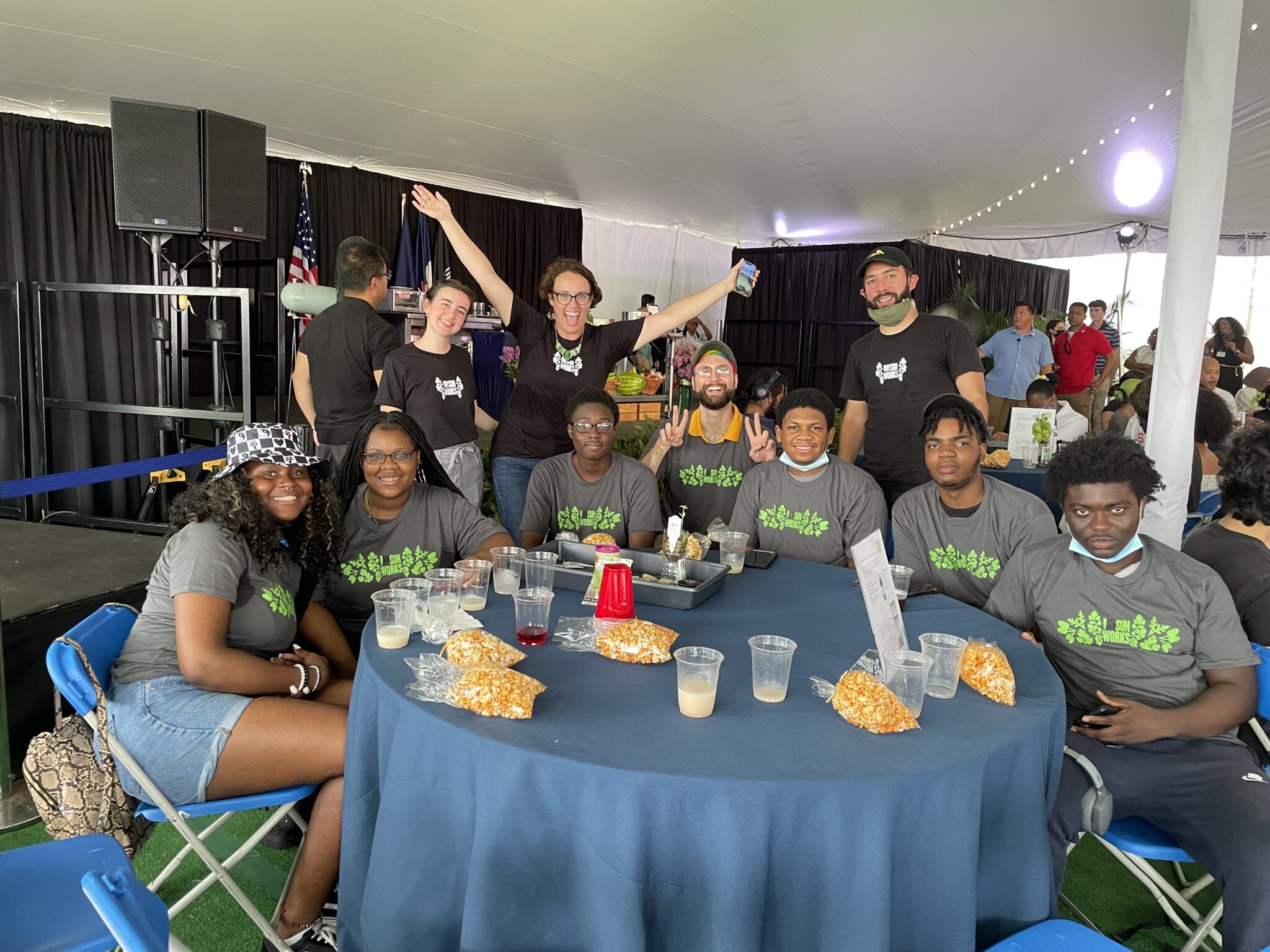
This week, we’re proud to announce that for the second year in a row, 33 high school students in our Workforce Development Program have officially graduated and attained professional certification in Controlled Environment Agriculture (CEA)! For the past several weeks, the young farmer-scientists from the High School for Innovation and Advertising in Media, East Brooklyn Community High School, and Thomas A. Edison CTE High School have been hard at work, spending their summer diving deep into the science behind hydroponics. As they prepare for entry into the perpetually evolving field of urban agriculture, these students have studied, practiced, tested, and have now officially gained certification in one of the fastest growing sectors of the green economy.
Originally launched in the Summer of 2022 with funding from the US Department of Agriculture (USDA), our CEA Workforce Development Program was the first of its kind in the city and helped connect students from Brooklyn and Queens with the Mayor’s Summer Youth Employment Program (SYEP). This program aims to address the need for youth workforce development programs in NYC, especially for students from underserved communities, and helps build a pipeline of skilled workers in hydroponic farming, a growing sector of the green economy in NYC and other major cities. Students at the High School for Innovation and Advertising in Media were paid via the city’s SYEP program, while those at the other two schools were paid through their school’s stipend program or other workforce integration programs.
join Mayor Eric Adams at Gracie Mansion!
Held in the students’ hydroponic classrooms, which are installed and maintained by NY Sun Works, the program uses experiential learning and practical assessments to help students understand and master building, operating, and troubleshooting a variety of hydroponic systems including the Nutrient Film Technique (NFT) system, the Vine Crop (or Dutch Bucket) system, and aeroponic tower systems. Students also master farming techniques including implementing pest prevention methods, identifying and solving nutrient deficiencies, and performing other water quality tests among other important marketable technical skills. To prepare them for entry into the professional world, students also journeyed to the NY Sun Works office on the Upper West Side to meet with our team and hone their career-building skills. Using workplace exercises including mock interviews and resume reviews, our goal was to help build confidence and familiarity with professional settings, so these future scientists and leaders can feel empowered to pursue their passions and achieve their highest ambitions no matter what career path they choose.
Congratulations to this newest class of farmer-scientists! We wish them the best of luck as they apply for jobs, colleges, or even return to their high school academics. We’re certain these bright young minds have even brighter futures, and are excited to welcome a new group of future climate scientists to our year and semester-long in-school CEA elective courses!
Blah
HARLEM WORLD: NY Sun Works Announces New Education Director And The Addition Of Hydroponic Specialists
New York Sun Works Director Manuela Zamora today announced Liz McKoy to fill the new role of Education Director. As well as addition 11 more hydroponic specialists will join the nonprofit organization.
Blah
The New York City Council Dedicates $5.3 Million in the FY24 Budget For Urban Agriculture & Climate Education
Amazing news for climate education advocates everywhere: 28 members of the New York City Council, including City Council Speaker Adrienne Adams, have dedicated a monumental $5.3 million to bring urban agriculture and climate education to the young people of New York, through the installation of hydroponic labs in public schools across the five boroughs and support of the NY Sun Works programming in our current partner schools.
New York Sun Works Executive Director Manuela Zamora applauded the Council’s decision this month, saying, “I want to thank the New York City Council Speaker Adrienne Adams and City Council Members for making a $5.3 million collective commitment in the Fiscal Year 2024 budget that will bring hydroponic farming technology and climate education to our city’s schools, and help cultivate the next generation of scientists, urban farmers, and climate activists. This significant capital investment to build new labs, through the School Construction Authority, will allow New York Sun Works to provide access to a hands-on urban farming experience that empowers young people to take the reins on sustainability science, climate change, and food insecurity in their communities. We are also grateful to our local elected leaders who allotted expense funding to New York Sun Works to ensure that we continue to support over 100,000 students at established 250 partner schools with existing labs. This transformative commitment will help thousands of students across grades and communities improve their learning outcomes and enrich their academic career.”
A critical component of our program’s approach to implementing urban agriculture technology and climate education in so many schools across NYC is integrating sustainability practices into the local community. City Council members play a vital role in the health and well-being of the neighborhoods they represent, connecting with residents not only on a political level but also on a cultural and personal one. By supporting substantial investments in building educational infrastructure to support the next generation of New Yorkers, our elected officials also support the right of all students to a sustainable future. There can be no doubt about the fact that the students of today will need to navigate lives and careers in a climate-altered tomorrow, and so it falls to leaders like those on the City Council to ensure students have the knowledge and opportunities they need to thrive.
The City Councilmembers who are helping cultivate the next generation of scientists, urban farmers, and climate activists are Joanna Ariola, Alexa Aviles, Diana Ayala, Gale A. Brewer, Tiffany Caban, Eric Dinowitz, Amanda Farias, Jennifer Gutierrez, Shahana Hanif, Crystal Hudson, Kristin Richardson Jordan, Shekar Krishnan, Farah Louis, Christopher Marte, Julie Menin, Francisco Moya, Mercedes Narcisse, Sandy Nurse, Vickie Paladino, Keith Powers, Lincoln Restler, Kevin Riley, Rafael Salamanca, Pierina Sanchez, Lynn Schulman, Sandra Ung, Marjorie Velazquez, and Julie Won.