TESTING donation page

MAKING JEWELLERY WITH USED PLANTS BY CHLOE CAPERS

My favorite group was Andrea, Freya and Isabella from West End Secondary School. Their presentation was interesting because they used leftover plants to make stylish jewelry. I liked their Hydro-Craftism project because they used plants that would have otherwise been wasted to make something new that you can wear every day.

I learned they used resin, molds and leftover plants from their garden to craft bangles, rings and other fun jewelry out of resin kits. It is extremely cool considering that those plants would have died or been trashed.
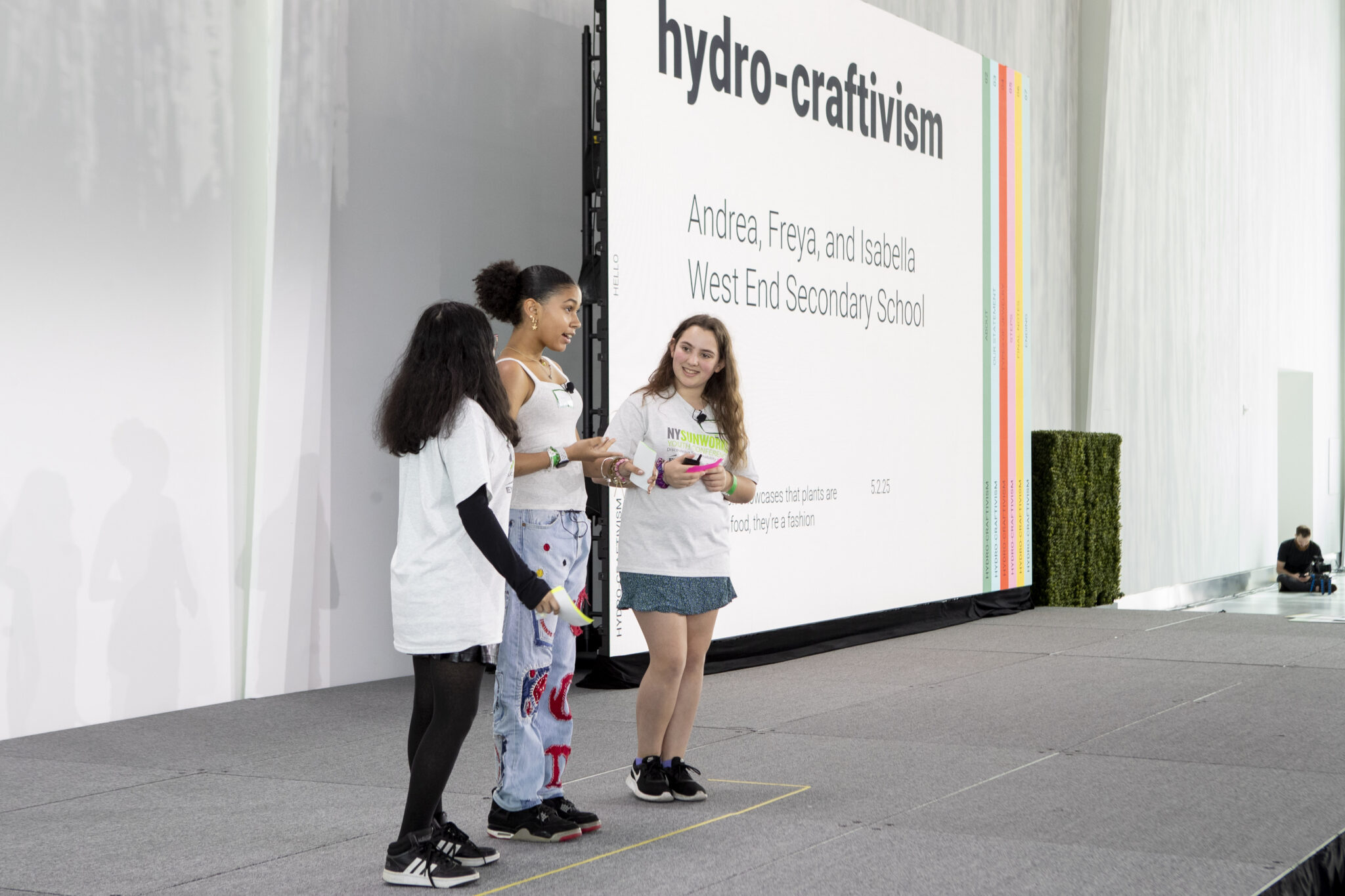
Andrea, Freya and Isabella from West End Secondary School delivering their presentation

Blah

IN SEARCH OF THE PERFECT PEPPER BY DANIEL MAYEN

As a Youth Press Conference member, I had the privilege of talking to a group of inspirational elementary school students about their search for the perfect pepper

In their experiment, Rex, Kali, and Nahuel from The Brooklyn Brownstone School sought to crossbreed plants like jalapeños and bell peppers to examine the impact on the spice level of the hybrid peppers. Interestingly, the students found that the taste profiles of the hybrid peppers gravitated towards extremes: The hybrid bell pepper was sweeter than the control bell pepper and the hybrid jalapeño was spicier than the control jalapeño.

Moving onto the next group of presenters, I spoke to Joseph, Jocelyn and Yaretz from Middle College High School in Queens. Their presentation “Hydroponic vs Soil Plant Growth” explored the pros and cons of growing plants in sand, gravel or liquid with added nutrients but without soil. The team concluded that hydroponic farming is more expensive than traditional agriculture, however hydroponics plants grow faster and in a more sustainable way. 

I also had the honor of meeting Alexis Harley, the Chief Risk and Resilience Officer at the New York Power Authority (NYPA). During the interview, I asked Alexis about the link between hydroponics and energy generation. In reply, Alexis highlighted how NYPA also looks for ways to lower carbon emissions and promote sustainability.

This conference opened my eyes to the creativity of people of all ages when it comes to hydroponic farming and how we can actively seek ways to sustain a better future for generations to come.

Rex, Kali, and Nahuel from The Brooklyn Brownstone School waiting to present

Blah

AN INTERVIEW WITH JAVITS CENTER CEO JOYCE LEVESTON BY DARLENE CAMAC

Every year, the annual New York Sun Works Conference invites students to come together and present their findings in Sustainability Science and contribute to the advancement of solutions to the world’s most pressing climate challenges. As a member of the Youth Press Team, I had the honor of interviewing the first female CEO of the Javits Center, Joyce Leveston.

“I hope to be the representation for women in leadership,” said Joyce.

Joyce spoke about how much pride she takes in maintaining the Javits Center’s rooftop farm, the largest of its kind in New York. The view over the New York cityscape from the rooftop farm is, for Joyce, the best that the city offers. Joyce’s participation in the conference itself stems from her desire to encourage students to get active in environmental projects. She deliberately kept her own opening presentation extra short to make sure the student presenters had more time to present their own projects. 

Moving on to talk about the student presenters, I had the pleasure of interviewing Elena, Lilly and Angel from JHS 218 James P. Sinnott about their presentation on aquaponic farming. The group’s experiment sought to find out if their aquaponic system containing Tilapia fish could outgrow a regular hydroponic tower system.

In their aquaponic system, waste from the fish is turned into nutrients with the help of bacteria, allowing plants to thrive through this underwater ecosystem. Fish waste was the only source of nutrients for the plants. Although both systems allowed plants to flourish, the hydroponic tower system was able to outgrow the aquaponic system, most likely due to the potency of the nutrients used.

For me, this annual conference illuminated the importance of science and experimentation to help build a greener future, not just for New York City, but for the world.

Javits Center CEO Joyce Leveston opens the 14th Annual Youth Conference

Blah

A FUN AND ENLIGHTENING DAY AT THE JAVITS CENTER BY ISRAEL COFIELD BREHON JR.

On May 2nd, 2025, my class from JHS 218 in Brooklyn went to the Jacob Javits Convention Center to participate in the 2025 NY Sun Works Youth Conference. The day started with my class taking the A train from Euclid Ave in Brooklyn to Manhattan’s 34th Street. When we got near the building we saw people greeting us with signs directing us towards the entrance.

When we got inside, we were assigned different seats. As a press member, I was on Team Basil. During each presentation I took notes on a clipboard. Following the presentations I had the opportunity to conduct three separate interviews with two groups of student presenters and Alexis Harley, Chief Risk and Resilience Officer with the New York Power Authority (NYPA).

The first group of student presenters were Adil, Ihaan, Zaiyan and Jannat from PS 214 Michael Friedsam. The title of their presentation was Finding an Alternate Substrate. I asked them “How many tests or experiments did you do to come up with your substrate?” They replied that they had completed many tests to find their substrate. 

In my second interview with Alexis Harley from NYPA I asked, “How did you know that this job was the right one for you?” Ms Harley said: “I didn’t really know. I jumped around from job to job, when I got to this one, I just had a feeling, this was the one.”

The third and final group I interviewed was Rex, Kali and Nahuel from The Brooklyn Brownstone School. Their presentation was entitled: Pepper Perfect 2.0. The first question I asked was, “What was the hottest pepper?” Their answer was, “The world’s hottest pepper is called Pepper X.” The second question I asked was,”How many different types of peppers are there?” Their answer was, “There are a variety of different peppers.” 

After the interviews, we went on a Farm Tour on the roof of the Javits Center. On the tour we visited two locations. The first place we visited was the outdoor section, where we saw many different plants. The guide told us about how bees were more active there during the summer. Afterwards, we visited the greenhouse towards the northern tip of the building. It had large air conditioners on the walls. The guide talked about how the greenhouse worked. We walked a bit more and found ourselves at some different plants. We saw strawberries and a plant called the Kangaroo Paw Plant. After the visit to the greenhouse, we went back to the auditorium to take pictures.

In conclusion, that was my full experience at the NY Sun Works 2025 Youth Conference. It was a very fun and enlightening experience. I learned a whole lot, like how you can use different substrates to grow plants. Also, what the hottest pepper was and how there are a large variety of peppers. Another thing I learned is how they are measured by “SHU” or in other words, Scoville heat units.

Adil, Ihaan, Zaiyan and Jannat from PS 214 Michael Friedsam present their work

Blah

EVERYONE LOVES SWISS CHARD AND THAT’S OKAY BY KARUN

Hello, I will be telling you about the people I interviewed about hydroponics. Hydroponics is an approach to growing plants without using soil. 

I interviewed Lenny, Nikolai and Aitan from the Rachel Carson High School for Coastal Studies about their presentation on Controlled Environment Agriculture (or CEA). It was my first interview so I asked very simple questions. All three presenters started in RCHS in middle school and all like planting the same plant – Swiss Chard. Sounds tasty!

What do all these abbreviations mean?

If you were wondering what CEA, FFA, and RCHS mean, I can tell you. CEA stands for Controlled Environment Agriculture. As you can see, this is about the environment and agriculture. Agriculture is the science or practice of farming. FFA refers to Future Farmers of America. You can also see that this is about farming and the future of people.

Finally, RCHS refers to Rachel Carson High School for Coastal Studies, the name of their school.

Conclusion

In a nutshell, this team of people helps lots of people learn about hydroponics and more.

Lenny, Nikolai and Aitan from the Rachel Carson High School for Coastal Studies prepare to hit the stage

Blah

SUSTAINABILITY SCIENCE IN FOCUS BY LILY INGBER AND AIDEN MUENCH

On May 2, 2025, 7th graders Aiden and Lily from the West End Secondary School arrived at the Javits Center to attend the 14th Discovering Sustainability Science Youth Conference. They interviewed three groups of presenters and questioned each group about how their chosen topic shed light on a specific area of sustainability science.  

Hydro-Craftism – West End Secondary School

The three 8th grade students, Freya, Andrea, and Isabella, focused on creating resin jewelry that captured the rich colors of leftover flowers and herbs from their hydroponic classrooms. Instead of leaving their surplus plants to waste, the students used them in an unconventional but astonishing way; creating accessories from rings and necklaces to coasters that pop. We found the students’ improvisation really inspirational in developing smart and non-wasteful ways to fight climate change.

Freya, Andrea, and Isabella during their presentation

Canopy Transpiration In Different Tree Species And Their Response To Soil Moisture In A Changing Climate – José Marti STEM Academy

12th grade student Jocelyn from José Marti STEM Academy, presented her project under the title Canopy Transpiration In Different Tree Species And Their Response To Soil Moisture In A Changing Climate. Jocelyn highlighted the rising temperatures across the globe in the past century due to human interaction and how these changes have resulted in a drier climate. She spoke about how the increasing frequency of fires  has laid waste to ever larger tracts of vital forests and rainforests. This problem jeopardizes both our oxygen supply and impacts the transpiration, the process in which water vapor rises from the stomata of leaves of plants and trees, assisting in the water cycle. When forest fires destroy copious amounts of plants and trees, both photosynthesis and transpiration are negatively affected. Jocelyn also presented solutions to climate change’s threats, such as: reforestation, growing crops that grow comfortably in hot, dry places, green roofs, and planting trees in urban areas.

Jocelyn is evidently not only against climate change, but seeks creative solutions to fight it.

Jocelyn’s project looked into the impacts of climate change on transpiration in plants and trees

Help from Fish – PS 181 John L. Steptoe

Three 6th grade students named Ethan, Khloe and Sabrina from P.S. 181 John L. Steptoe focused on the beneficial role of fish waste in providing nutrients within aquaponic systems. The students outlined how fish waste is broken down into nitrates, which the plants then absorb as nutrients. Instead of giving the plants artificial nutrients to help with its growth, the students used natural fish nutrients. Not only do the fish give nutrients to the plants, but the plants also provide a safe and healthy environment for the fish. For instance, when the plants take up the fish waste, the plant is cleaning and filtering the system providing a healthier environment for organisms.

Overall, all of these young presenters have shared many creative and efficient ways to fight climate change, finding unlimited ideas in a limited Hydroponic Classroom space. 

Ethan, Khloe and Sabrina from P.S. 181 John L. Steptoe wanted to explore the benefits of aquaponics

Blah

GATHERING OF SUSTAINABILITY MINDS AT THE 2025 NY SUN WORKS YOUTH CONFERENCE BY MARCUS FIQUET AND SEBASTIAN FIQUET

NY Sun Works is a nonprofit organization that helps students learn about taking care of the Earth and being eco-friendly. Since 2011, NY Sun Works has organized a youth conference each year, where students can share their discoveries in hydroponics with their peers from other schools. This year’s theme was ‘Discovering Sustainability Science’ and it was all about teaching students smart ways to protect our planet.

On May 2nd, 2025, the Javits Center in NYC welcomed over 900 students from elementary to high school for the NY Sun Works Youth Conference. Joyce Leveston, CEO of the Javits Center, highlighted the special setting, where students can “enjoy the farm and the view of the waters around NYC,” while sharing their research and their science projects about helping the earth. 

This year, six enthusiastic 5th graders from PS 199 were among the attendees.  We participated in the presentations, learned a lot from other attendees, and had an awesome experience!

The conference presentations were categorized under three themes: Grow, Innovate and Act:

First, during Session 1 – Grow, we observed a presentation called “Hydroponics vs Soil Plant Growth,” during which students showed how they grew plants using a hydroponics kit “that’s growing without soil!” One school compared hydroponically grown plants with soil-grown plants and found that hydroponic systems use less water and less CO2 but use more energy and are more expensive to maintain.  Another school discovered that roots grow downward due to gravity and without gravity they would have trouble growing in the hydroponic system. Some schools used leftover plants to create items such as art and jewelry: “We realized one day that sometimes we have too many plants. While harvesting, there was an overflow of plants that not everybody was able to take home. So we came up with an idea: What if we turned them into everyday art and jewelry?” 

PS 199 presented on Integrated Pest Management. This presentation shared different ways to get rid of harmful insects called Thrips and discovered that we could get rid of bad bugs with good bugs like Ladybugs, Minute Pirate Bugs, Hypoaspis Miles and Green Lacewings.  

In Session II – Innovate, students made up awesome inventions like living statue gardens and systems where fish provide nutrients for growing hydroponic plants. We also saw a presentation from NASA Program Scientist Dr. Elison Blancaflor who spoke about how NASA was looking for ways to grow vegetables in space to help absorb CO2 and emit oxygen. We learned that astronauts really miss eating fresh vegetables when they are in orbit. 

Hunter College Elementary School used different colored plastic screens to test which color of light helps plants grow faster. They discovered that under yellow light, lettuce grew the fastest and red light came in second and they said, “this is not consistent with most of the published literature.” Jocelyn from José Marti STEM Academy in New Jersey studied water transfer from root to treetops and suggested that hydroponic growth can be a more stable environment for growth because of the increased droughts: “Tree species like Sugar Maple and Black Walnut that once thrived in stable climates and environments are now under stress.”

Third, in Session III – Act, we learned how to help our neighborhoods be greener.  One school looked at the nutrients in hydroponically grown cucumbers.  Another school investigated how to cross pollinate peppers to get the best taste.  And yet another school showed the health benefits of tea and the potential for faster growth of tea leaves in a hydroponic system. 

The NY Sun Works conference gave its farmer scientists a chance to share what they learned while working on our projects, while learning from each other at the conference. And finally, we learned that communication is just as important as innovation.  

The NY Sun Works conference is a way to share our discoveries, learn from each other, and to inspire the future. It was super fun and made us want to help save the planet even more!

Deon, Aleekah and Kimora from Brooklyn Democracy Academy present on the benefits of different nutrient sources

Blah

WHEN APHIDS COME CALLING, WE KNOW WHAT TO DO BY MEE’AH BRITTO

I had the pleasure of attending the NY SunWorks 14th Annual Youth Conference and I loved my experience with being on the press team. I learned so much from each and every presentation and I enjoyed being able to interview different groups and understand different perspectives from people.

I interviewed Miles, Rohan, DJ, and Parker from PS 199 Jessie Isador Straus in Manhattan for their presentation entitled ‘Bad bugs. Bad bugs. Whatcha gonna do?’ They explained their journey of growing lettuce and everything they did to help the lettuce in their hydroponic lab. 

They had a great experience, but they had one problem: aphids. 

“Aphids feed on sap, making our lettuce weaker. They also carry diseases, which make it harder for us to eat what we grew, so we needed to move fast,” they said. 

Each presenter talked about the difficulties they faced trying to get rid of aphids and the different approaches they tried to resolve the issue: “Strong sprays of water, natural repellents and better bugs such as ladybugs, lacewings and hoverflies helped, but due to the aphids’ size it was hard to get between every groove and crack in the lettuce,” they said.

Their main focus was to get rid of these bad bugs because of what they can do to their lettuce and the rest of their plants. Even though they didn’t fully solve their problem, they are determined to find a better solution using next year’s hydroponic lab. This is very important to them because they believe that once they find a solution, they will be able to help other people who face the same problem. 

This experience taught me to be more observant to the plants that I grow and that protecting plants from pests keeps them healthy.

Miles, Rohan, DJ, and Parker from PS 199 Jessie Isador Straus talk to our Youth Press Team after presenting

Blah

SUCCESS COMES FROM WORKING TOGETHER BY PALOMA MORAN

Hi! My name is Paloma Moran and I will be talking about the hydroponics presentation, “Pepper Perfect 2.0” by Nahuel, Rex and Kali from The Brooklyn Brownstone School.

This presentation was about cross breeding peppers – in their example, jalapeños and bell peppers. They used two control peppers: one jalapeño and one bell pepper, and created two hybrids: one hybrid bell pepper and one hybrid jalapeño. One thing I learned from this presentation is how to crossbreed jalapeño and bell peppers. 

I learned from this interview that they all succeeded by working together. And lastly, My favorite part of the conference was how they made their chart on the peppers from spiciest to least spicy. 

In conclusion, I think that this experiment was very interesting to learn about. Have a good day everybody.

Nahuel, Rex and Kali from The Brooklyn Brownstone School during their presentation

Blah

YOUTH PRESS TEAM ARTICLE BY ZOE GARELICK

My favorite group that I interviewed were Yaretz, Joseph and Jocelyn from Middle College High School in Queens, whose presentation was titled ‘Hydroponics vs. Soil Plants Growth.’  They did a very good job of giving evidence and conveyed a lot of helpful information. Their presentation was about hydroponics. They chose this because they wanted to learn more about hydroponics. They also wanted to watch the plants the full time instead of only sometimes.

I learned that they chose hydroponics because they thought a lot of people were doing hydroponics and they wanted to compare theirs to the other groups. They also learned all hydroponics are self-watering instead of a person having to water the crops. 

In conclusion, they learned a lot about hydroponics. 

Yaretz, Joseph and Jocelyn from Middle College High School speak with one of the Youth Press Teams

Blah