TESTING donation page
A New Milestone for NY Sun Works
Click Here To Make a Donation Today!
Blah
High School Curriculum Expansion
The NY Sun Works Discovering Sustainability Science High School curriculum consists of subject-specific labs and modules that introduce students to hydroponic farming, offer students the opportunity to design and build their own hydroponic and aquaponic systems, and connect to topics covered in life science courses such as Living Environment, AP Environmental Science, and AP Biology. The Education team is excited to announce that four new modules (Farming Foundations, Farming for a Sustainable Future, The Hydroponic Games: A Hydroponic Design Challenge, and The Aquaponic Games: An Aquaponic Design Challenge) are now available on the NY Sun Works Learning Center! Keep reading for an overview of each NEW module and descriptions of existing labs.
Farming Foundations
This module provides the intellectual and practical infrastructure for students and teachers as they embark on their mission to maintain a fully-operational hydroponic farm within the context of a science lab. This foundation unit speaks directly to the unique systems and practices found within the Greenhouse Classroom and helps students keep their farm running throughout the school year, while introducing them to hands-on investigations that can be designed and implemented in the hydroponic systems.
Farming For A Sustainable Future
This module provides students and teachers a deep dive into hydroponic and aquaponic farming and sustainability. The lessons complement the Land and Water Use Unit of the AP Environmental Science curriculum with a focus on the impacts of agricultural practices, including irrigation and pest control methods and impacts of overfishing. Students also engage with sustainability topics (impacts of urbanization) and examine their own ecological footprints on the path to discussing and determining what sustainable agriculture looks like in practice.
The Hydroponic Games: A Hydroponic Design Challenge
This module engages students in an engineering design challenge to design and build functioning hydroponic systems. Working in groups, students use the iterative design process to revise their system designs and provide constructive feedback to each other throughout the module. Students also have the opportunity to apply what they have learned about water chemistry and how hydroponic systems work to ensure their systems function and support the growth and development of multiple crops.
The Aquaponic Games: An Aquaponic Design Challenge
This module engages students in an engineering design challenge to design a functioning aquaponic system. Working in groups, students use the iterative design process to revise their system designs and provide constructive feedback to each other throughout the module. Students learn about the major threats to ocean biodiversity and have the opportunity to design and implement controlled experiments in an aquaponic system. This module also includes instructions on how to build a 10-gallon aquaponic system should an aquaponics tank not be present in the classroom.
Living Environment Labs
In this lab series, students identify how energy affects the life cycle of the plant. Students are asked to explain how energy and matter are interconnected through each phase of plant development: seed & embryo, roots & shoots, leaves & stems, and flower.
Chemistry in Hydroponics Series 1: Introduction
In this lab series, students investigate the features of hydroponic farming while practicing Chemistry Regents concepts. Each lab offers a Daily Guiding Question, Objectives, NYS Physical Setting/Chemistry Standards, Scientific Inquiry key ideas and performance indicators, notes for the teacher, and a Lab Student Page.
Chemistry in Hydroponics Series 2: Color
In this lab series, students investigate the features of hydroponic farming while practicing Chemistry Regents concepts. Each lab offers a Daily Guiding Question, Objectives, NYS Physical Setting/Chemistry Standards, Scientific Inquiry key ideas and performance indicators, notes for the teacher, and a Lab Student Page.
But that’s not all! High School teachers should be on the lookout for a new lab series (Chemistry in Hydroponics Series 3: Biochemistry) and the NY Sun Works Research Guidebook, which are currently in development and will be available on the Learning Center in the Spring of 2021.
As always, teachers should not hesitate to contact us with any questions about lessons or labs.
Blah
NY Sun Works PL Series: The Power of Observation
 Every November the NY Sun Works Education team hosts a professional learning session for our partner teachers. The session usually takes place in-person, in one of our Greenhouse Classrooms, surrounded by vine crops, leafy greens, and the soft bubble of the aquaponic system in the background. This year, as the DOE’s transition to full-remote learning loomed and eventually touched down, NY Sun Works took the PL to a virtual platform. Partner teachers gathered across four boroughs to share, explore and discuss “The Power of Observation” in this year’s November PL.
Teachers explored together the potential of cultivating joy, focusing on observation and its particular uses in this complicated learning landscape. We shared virtual tools to record data and present findings, as well as re-discovered the natural curiosity that is found in growing plants through the hydroponic process.
We brainstormed ideas and shared best practices, while exploring the new curricular offerings (including NEW lessons focused on the process of germination!) and virtual tools found in the NY Sun Works Learning Center. We particularly enjoyed talking through the challenges of our not-so-simple task of fostering confidence in our Farmer Scientist students in a remote setting.
Our three hour-long sessions flew by and we all left with a refreshed excitement for the magic of germination, a better understanding of the tools and new lessons available to us, and the inspiration to facilitate living laboratories in our students’ remote learning spaces. We also spent some time connecting with colleagues, exchanging tips and ideas, while building connections between hydroponic-veteran and first-time teachers.
Stay tuned for a future announcement about Spring 2021 Professional Learning opportunities, and as always don’t hesitate to reach out to Hannah (hannah@nysunworks.org) or Elaine (Elaine@nysunworks.org) with any questions.
Blah
Home Hydroponic Kits: LAST CALL for FALL ORDERS
Our new Home Hydroponic Kits have been a terrific success and we only have a few more available for the fall semester. If your school is interested in purchasing some for the fall, please sign up here by November 30: Fall Home Hydroponic Kit Request Form.
But don’t worry! Our team will be putting together more kits in January for spring courses! A new Spring Request form will be posted in December.
Kits have been used in K-12th grade – primarily for at-home remote learning, but also in the classroom when students aren’t able to visit the hydroponic lab due to social distancing requirements. Some new schools that do not yet have a greenhouse classroom have also been able to use the Kits and stand-alone curriculum, and we are excited to begin this new type of partnership.
The NY Sun Works Home Hydroponic Kits enable students, with teacher guidance, to grow, study, and run investigations with plants from home or in the classroom. The lessons, in combination with the kits, aim to introduce students to topics they would otherwise be learning about in their Greenhouse Classrooms. The Kit and lessons are intentionally designed to create flexibility for teachers to bolster and incorporate content of the courses that are already being taught (such as Living Environment, AP Biology and AP Environmental Science at the high school level). Each lesson is accompanied by a student-facing Google Slides presentation.
Blah
Wrapping Up Home Hydroponic Kit Fundraiser – Thank You for Your Support
As we wrap up our Fall Home Hydroponic Kit campaign, we’re happy to share that we’ve delivered over 4,000 kits to public schools so far, with deliveries continuing through the fall. And, thanks to the generosity of our NY Sun Works community, we were able to provide more than 3,100 kits at no cost to schools that need financial support due to COVID-related budget cuts. If you’d like to help support the campaign, there’s still time! Please click here to make a contribution.
The kits have met with resounding enthusiasm from teachers and students alike. “This feels like Christmas,” said one 8th grader at PS 122 in Queens on opening her kit. Her teacher said the classroom was buzzing as the kits were handed out with students talking about the plants they’d be growing and how they’d care for their plants. The kits and curriculum have been a lifesaver, she also shared, bringing joy and something to look forward to each day for students that have been struggling with remote learning and being stuck at home.
Each kit costs only $12 and is designed to engage students with STEM topics they would otherwise learn in their Greenhouse Classrooms at school. With teacher guidance and paired with our science lessons, students have the chance to grow, study, and run investigations while growing lettuce and other edible greens from home as well as practice observation, data collection, and other critical STEM skills.
Be sure to keep an eye out on social media and in our next newsletter for photos of kids and their projects with the kits!
Blah
November Professional Learning Opportunities
The week of November 16th, the Education team will be offering a professional learning opportunity for our Greenhouse Classroom Teachers. During the 1 hour session, The Power of Observation, we will share tools designed to encourage and support students as they practice close observations, connect to and learn about plants and sustainability, and even create living laboratories at home. These tools encourage student learning (data collection and observation) outside of class time and away from the computer, and can help teachers track student learning and engagement. We will also review the variety of resources available on the NY Sun Works Learning Center that encourage and facilitate students to practice close observation skills, collect and analyze data, design investigations, and more. NY Sun Works is honored to be able to provide teachers and students with resources to support learning about sustainability science, urban agriculture, and hydroponics during the 2020-2021 school year.
The same session will be offered three times the week of November 16th. Please use the links below to register for the session that works best for your schedule.
If you have any questions, don’t hesitate to contact Hannah Jaris (hannah@nysunworks.org).
Blah
Indoors or Outside, Growing Plants Helps Support Students’ Emotional Well-Being
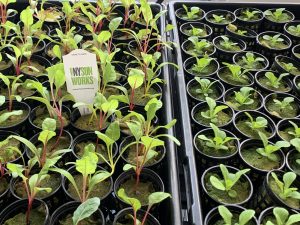
In a regular year, time in our Greenhouse Classrooms doesn’t just help students build proficiency in STEM and sustainability — it also supports students in their social-emotional learning. Now, with access to the Greenhouse Classrooms limited due to COVID and with many students learning remotely, our Home Hydroponic Kits are filling this role instead. The Kits are designed to engage students with topics they would otherwise learn about in their Greenhouse Classrooms. But the hydroponic kit lessons also deliberately incorporate activities to foster social-emotional well-being. For example, each day, students are tasked with observing and tending to their plants, creating a stabilizing routine and something to look forward to each day. The opportunity to share their progress and challenges with their classmates and teachers fosters a spirit of collaboration and curiosity as students talk about what has worked and why. And sharing food with their family – even just a leaf or two of kale or herbs – creates a deep sense of pride and brings the whole family into the learning experience.
Whether in the Greenhouse Classrooms, at home with a plant on the windowsill, or outside in a garden plot, students gain a wealth of scientific knowledge and farming know-how from tending plants. But just as important as academic learning are the emotional benefits that come from cultivating plants — the sense of responsibility in caring for a living, growing thing, the pride and confidence in helping it grow, and the stability that comes from a daily gardening routine. These benefits — always important to a child’s social-emotional well-being – have become even more crucial now as students contend with the uncertainty and instability of their lives during the pandemic.
Numerous studies have confirmed what gardeners intuitively know: that gardening and growing food promote emotional well-being. The benefits range from reducing stress and anxiety to elevating mood and alleviating depression. Among students, caring for plants has been shown to foster a sense of responsibility, accomplishment, and self-confidence; growing edible plants has the added benefit of helping students develop more healthful eating habits and a more positive relationship with food. Caring for plants is also a way for students to grow their community, as they bond with classmates over the successes and challenges of cultivating plants and share their progress and the food they’ve grown with their family and neighbors.
All of these benefits fall within the broad category of Social-Emotional Learning (SEL). An important part of K-12th grade educational programs, SEL is the idea of supporting students in understanding and managing their emotions, building self-confidence, and learning to communicate constructively with others. In science, SEL extends to helping students gain confidence to ask questions and explore new ideas, to know it’s okay to try and not have an idea work out as hoped, and to collaborate and build trust with their classmates. In designing, implementing, and analyzing experiments, students find agency, confidence and a sense of control that carry over into other aspects of their academic and personal lives.
Students are contending this year with so many questions they shouldn’t have to ask: Will I get sick if I go to school? Will remote learning be enough? Will my parents be safe in their front-line jobs? In many of our partner schools, students face the added daily stresses of food insecurity, family members out of work, and high death counts in their communities. As educators, we must use every tool we have to support students through this difficult time. The chance to cultivate a plant, to experience the joy of watching it grow, to harvest and share the food they’ve grown with their families and school community, is the chance for students to build the resilience and confidence they need and deserve.
Blah
Home Hydroponic Kit CURRICULUM Now Available
NY Sun Works previously shared information about our new Home Hydroponic Kit – designed to allow students, with teacher guidance to grow, study, and conduct experiments with plants from home or in the classroom. In addition to the Kits, we have been working on supports for our teachers to aid in teaching with the Kits. We are excited to share that the first set of lessons (including student-facing Google Slides) for grades K-5, 6-8, and 9-12 are now available on NYSW’s Learning Center! Teachers with access to the Learning Center will find them at the top of the TEACH page, in the Home Hydroponic Kits section.
This first set of lessons do not require students to have the Kits, so can be used right away while you await your Kit delivery. These lessons aim to access prior knowledge and build excitement about growing plants at home through asking students to think about where their food comes from, plant parts, plant life cycles, data collection, and introducing hydroponic farming technology — how it works and how it allows us to grow food in urban areas.
The next set of lessons that DO require the Kits will be available NEXT WEEK, coinciding with the beginning of Kit delivery to schools. These lessons introduce students to growing plants with water and nutrients, how to track and collect data about plant growth and development, and how to care for the plants as they are growing. If your school is still interested in requesting Home Hydroponic Kits, please go to this link: https://forms.gle/PKrYFCKXN35p5vE76.
The final set of lessons will be available by the end of October and introduce extended scientific investigations that can be set up with the remaining Kit materials. Note: students will need to collect additional materials depending on the investigation (e.g., recycled single-use plastic water bottles, string, chopsticks, or cardboard).
If you have any questions regarding curriculum support, please contact Hannah Jaris (hannah@nysunworks.org).
If you have any questions regarding proposals or pricing, please contact Megan Nordgrén (megan@nysunworks.org).
Blah
NY Sun Works Donation of Fresh Vegetables to Community Center
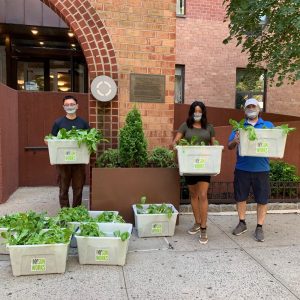 In an exciting partnership with Manhattan Borough President Gale Brewer’s office, NY Sun Works donated approximately 40 pounds of fresh vegetables to Goddard Riverside’s Phelps House, a community center. The lettuce, arugula, bok choy and basil were grown in the non-profit’s flagship hydroponic greenhouse at PS 333 Manhattan School for Children. PS 333’s Principal Claire Lowenstein was excited to participate in the harvest and proud that her school community could provide fresh food to neighbors in need.
This is part of NY Sun Works’s efforts to help schools and communities facing food insecurity to provide fresh vegetables to those in need. With the covid-19 school scheduling changes, schools that are unable to use their hydroponic labs for in-person learning have the option to run their hydroponic lab as an urban farm. The average school lab can grow up to 25 lbs per 6-week harvest, which is a LOT of lettuce!
Another Manhattan school is eager to join in this effort. “I think it’s amazing that the lab can provide food for families. The PTA is already coming up with bags of groceries. The fact that a program like NY Sun Works can step in and not only teach kids about hydroponics but also provide food for families in need is priceless,” shared the hydroponic lab teacher.
Blah
Stories From Our Partner Schools
A Teacher’s View: Lamesha Self, from PS 180 in Harlem
“We’re all learning here. We’re learning to be more flexible than we ever thought we’d have to be.”
Lamesha Self is the hydroponics teacher at PS 180 in Harlem, where she teaches K-5th graders how to grow food hydroponically and all about science and sustainability through the lens of urban farming. A teacher for 18 years, this past year was Lamesha’s first year in the hydroponics lab. She talked with NY Sun Works in August about why she likes the hydroponics program, what this past year has been like, and how she’s preparing for this upcoming school year.
How do you like teaching in the Greenhouse Classroom?
The hydroponics program starts children and their families thinking – because children come home and teach their families – about a different way, a healthier way of thinking about food. Kids are so enthusiastic about fruits and vegetables and growing food organically, and it’s so exciting to see the kids’ enthusiasm.
The program opens up ideas, things students never would have thought about before. Like that farming isn’t just on regular farms, that it can happen in urban farms, and that traditional farming isn’t sustainable. We can’t keep knocking down the forests and putting pesticides on the ground. Kids love that this is organic farming. We don’t even use organic pesticides.
The lab is a major part of the school. No school tour is complete without visiting the hydroponics lab!
What was it like when schools shut down?
When COVID began, we’d just completed a harvest and were beginning a new seeding process. I took the seedlings home and put the worms in the surrounding school garden. Every Monday, I recorded a video about the nursery which I uploaded to Google Classroom to show kids what was happening with the plants. The kids were so excited to see the plants growing and had so many wonderful things to say.
We also talked about what plants they were growing at home and if they were eating foods with seeds. I suggested they try planting seeds or dry beans. Since some kids didn’t have plants at home, I created interactive video lessons where they could recreate the process on screen, like growing a sunflower, planting the seed, and watering the sprout.
But it was challenging for the kids. They weren’t used to remote learning. In the lab, they got to touch the seeds and the plants. I know they missed the lab because they kept sending messages like, ‘I miss you Miss Self. I miss being in class. I miss planting the seeds and growing the vegetables.’
How are you preparing for the new school year?
Hopefully my school will receive a grant to continue with the hydroponics science lab. Unfortunately, we are just waiting to hear back at this time. Without the grant my principal informed me that there’s not enough money in the budget because of budget cuts.
However, if we receive the grant and are back with a hybrid, I will be an in-person teacher. The lab will run as usual. The kids, however, will not travel to the lab so I’ll possibly teach virtually or travel to my students’ classes. l would also record videos of lessons and the plants’ progress. With the hybrid, the kids will have to make portable hydroponics using water bottles just like they successfully did when we left in March because of COVID.
During remote teaching this spring I was able to successfully have a remote science fair, so I’m also looking forward to seeing a lot more hydroponic science projects because I was definitely impressed with the few I had this year.
We’re all learning here. We’re learning to be more flexible than we ever thought we’d have to be. No one has a choice but to be flexible.