TESTING donation page
A JOURNEY I WON’T FORGET ANYTIME SOON BY AYDEN BALL
As we arrived at the Jacob Javits Center on May 2nd we were greeted by two NY Sun Works staff holding signs that alerted us that we had made it to our location. That was just the beginning of a journey I won’t forget anytime soon.
As we arrived, our school’s Grow Support Team member, Trevor, provided us with green wristbands to enter the conference hall. We separated into two groups: the Press Team and the Presenters. I was a press team member in the Pepper Group. My role was to interview student presenters from schools across the city and adult sponsors.
The first person I interviewed was Arlanys from Careers in Sports High School. Her project was about how food coloring can affect plant growth. The first question I had for her was “How long did your project take to finish?” Arlanys told me that her project took just over a week to complete. Personally, this was the second most interesting investigation out of all the presentations because it was something I had never seen before. It was really interesting to see something different.
The second group I interviewed comprised Clara, Alice and Jorge from the Robert E. Bell Middle School. Their investigation was titled: Lacto-Fermentation, Cross Pollination, Aphids in the House. I asked the group how long it took to complete their experiment and they responded that it took “a few weeks.” I also asked them to rate their experience on a scale of one to ten, to which they replied ”on a scale this was a ten.”
After a few more speeches we ate lunch, but even before we had lunch the experiments the other schools presented were amazing. The experiments are something I could never forget.
During the farm tour, we got to see the variety of crops being grown on the roof of the Javits Center. The best fact I learned from the guide was that even bats benefit from the growth of the apple trees.
My personal take on this experience is that NY Sun Works and the Jacob Javits Center exhibit awesome projects and people. I would like to give a special thanks to the people that I interviewed and the outside presenters: Alexis Harley, Dr.Elison Blancaflor, Joyce Leveston and Te’lario Watkins II.
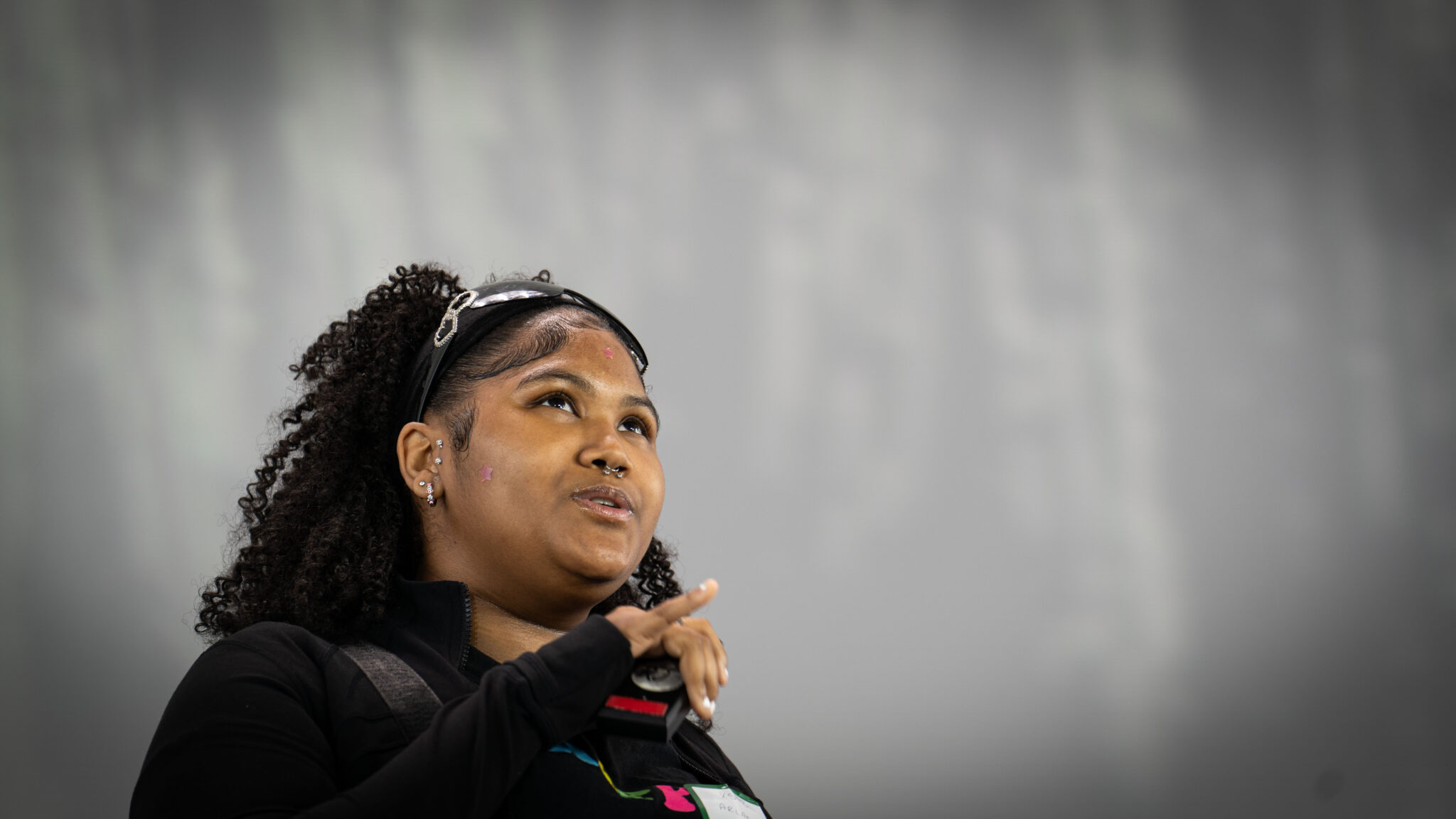
Arlanys from Careers in Sports High School presents her research on the impact of food coloring on plant growth
Blah
CREATIVE PRESENTATIONS TAKE PRACTICE BY ALOYSIUS STEWART
On the 2nd of May, 2025, I was given the opportunity to go to the Jacob Javits Center in Midtown Manhattan as a Press Team member! It was a very nice experience.
When we arrived, the place was very clean and empty. There was a couch in the middle of the room. We took an elevator up to the top floor, where the presentations were taking place. There were a lot of different schools, both the audience and the presenters. There were really nice, interesting and creative presentations that were on stage.
The first person I interviewed was Jocelyn from the José Marti STEM Academy. In relation to her presentation, “Canopy Transpiration In Different Tree Species and Their Response to Soil Moisture in a Changing Climate,” I asked Jocelyn, “What inspired you to produce this presentation?” Her response was that she was inspired to make this by the Los Angeles wildfires that happened earlier in the year.
In my second interview I spoke to Richard and Marquis from the Bronx School for Continuous Learners. Their presentation was titled “Self-Drained Hydroponic Sustainable Working Model.” I asked them, “What did you do to prepare for this presentation?” The two and their teacher said that they put all their effort into the work and said that they practiced the presentation many times.
For my final interview I spoke to Luna, Nina, Lily, Jet and Malina, from PS 84 Jose de Diego. In relation to their presentation, “The Importance of Nutrients.” I asked them, “Did you feel anxious about presenting?” The five presenters responded that they were really anxious, but at the same time, excited to present the importance of nutrients!
After the wonderful presentations, we ate lunch. We could choose between mini falafel sandwiches and mini turkey sandwiches. When we finished those, we got a tour of the roof, which was very interesting and awesome to be in! There was also a bus depot near, so it was a really nice sight to see!
Overall, the experience was amazing! The presentations were all awe filled and interesting and I’m glad I got to go with my peers at JHS 218!
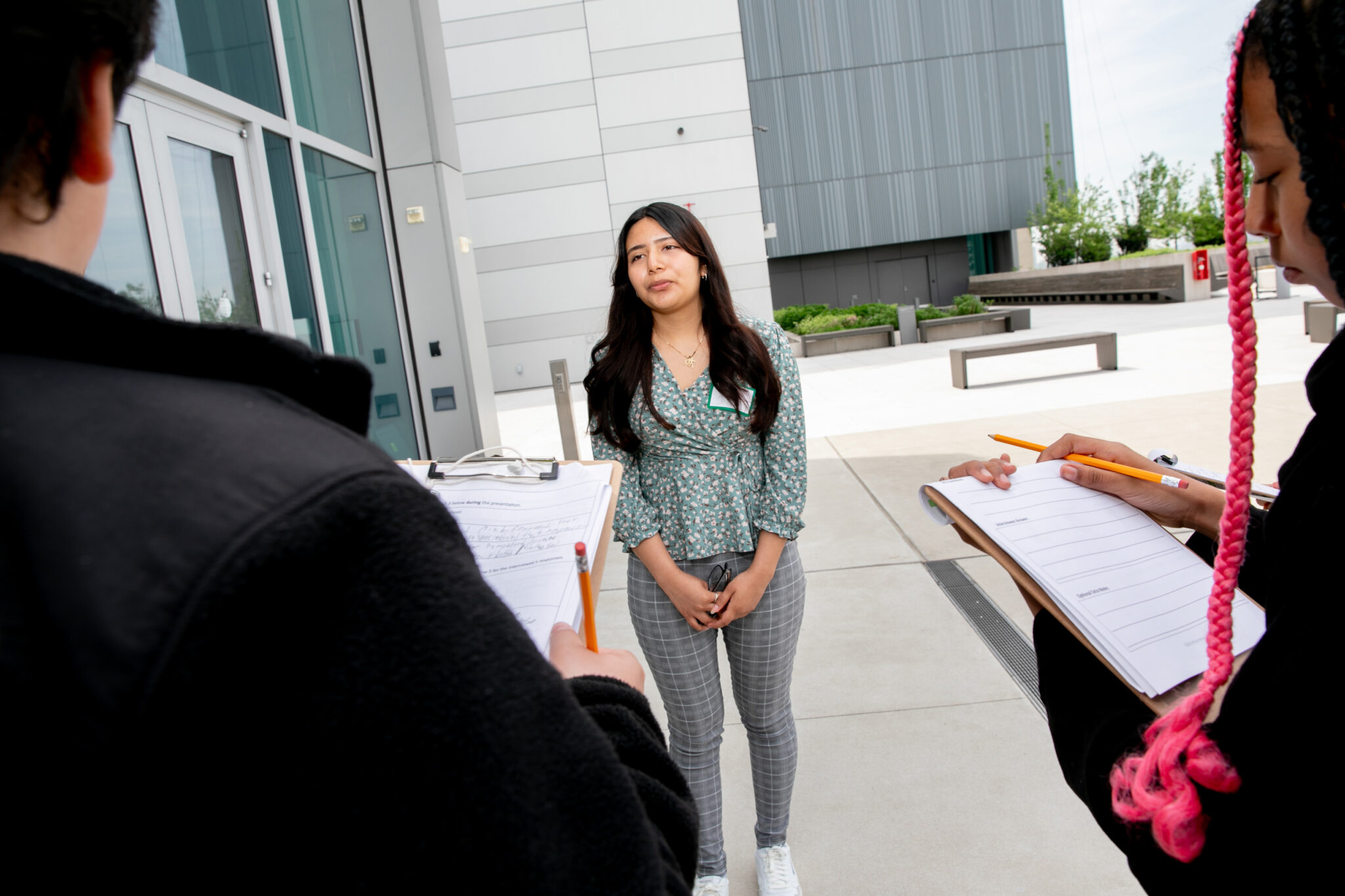
Aloysius and his group interviewed Jocelyn from the José Marti STEM Academy.
Blah
CIVICSCITV: How students become ‘farmer scientists’ in hydroponic classrooms — From NYC to Birmingham
In this episode of CivicSciTV’s “Local Perspectives,” host Diya Dwarakanath interviews Manuela Zamora, executive director of NY Sun Works, a non-profit organization introducing hydroponic labs in classrooms serving over 140,000 students. Hydroponic classrooms are transforming K-12 science education by integrating sustainability, hands-on learning, and food access into the core curriculum. “What better than growing food in your classroom year round with your peers and the teachers and sharing that with your families?” asks Zamora.
Blah
CBS NEWS: New York Sun Works Brings Nature into NYC Classrooms
Bringing nature into a classroom is one of the missions for an organization called New York Sun Works. CBS News New York’s Erica Lunsford visited a school in the Bronx and shows us how students are learning in a unique way.
Blah
VERTICAL FARM DAILY: Bronx Hydroponic Classroom named after Trailblazing Botanist Marie Clark Taylor
NY Sun Works gathered with Bronx Borough President Vanessa L. Gibson, school leaders, teachers, parents and students at KAPPA MS 215 in the Bronx on April 28 for the ribbon cutting ceremony of a new hydroponic classroom designed to foster a love of science, nature and gardening among students.
Blah
Birmingham City School Students get their First Taste of Hydroponic Farming this Fall
A First-Of-Its-Kind In The Nation, The Initiative Brings Innovative, Food-Based, Sustainability Science Education to 3,700 Birmingham Students in 8 Schools Through State-Of-The-Art Hydroponic Technology.
A $500,000 Investment Supports A National partnership between New York based NY Sun Works and Birmingham based Jones Valley Teaching Farm to introduce project-based science learning focused on environmental stewardship while tackling chronic absenteeism and food insecurity.
BIRMINGHAM, AL – Jones Valley Teaching Farm, NY Sun Works, and Birmingham City Schools today announced a groundbreaking initiative to bring comprehensive hydroponic farming to eight Birmingham public schools for the first time. This initiative will provide a range of benefits to Birmingham City Schools students and the greater Birmingham community, including engaging hands-on learning that drives student attendance, new pathways to higher education and careers, and thousands of pounds of freshly grown produce that stays in the community.
Each of the participating schools, including two middle schools, one K-8 school, and four elementary schools that all feed to the same participating high school, will be equipped with state-of-the-art hydroponic technology including growing towers, vine crop systems, seedling stations, and worm composting. Together, these provide a comprehensive, hands-on urban agricultural education experience. The six hydroponic classrooms and two hydroponic greenhouses are being designed and built by NY Sun Works, a NYC-based nonprofit recognized for delivering high-quality, standards-based sustainability education through advanced hydroponic systems.
The initiative builds on Jones Valley Teaching Farm’s nationally recognized Good School Food education framework that brings hands-on, food-based education into the classroom, fostering joy and curiosity around STEM education alongside the powerful act of growing food. In their new Hydroponic Classrooms, students will learn how to grow plants such as leafy greens, herbs, and vine vegetables, seed-to-harvest, using just water and nutrients.
“Our ultimate goal is to deliver food-based education to all 20,000 students in Birmingham City Schools,” said Jones Valley Teaching Farm Executive Director Amanda Storey. “This expansion allows us to reach more students and diversify how we use food as a foundation for learning by leveraging national resources to work alongside our trusted partners, Birmingham City Schools.”
Jones Valley Teaching Farm invited NY Sun Works to partner on this initiative based on their 15 years’ experience educating students in sustainability science through hydroponic farming. NY Sun Works has built and supported over 350 hydroponic classrooms in New York City, the nation’s largest public school system. They have also designed and implemented the associated curriculum, trained over 1,400 teachers, and now reach more than 140,000 students annually.
In addition to the equipment and infrastructure, teachers will receive ongoing training in the NY Sun Works standards-aligned science curriculum that fully leverages the hydroponic systems and engages students in the joy of this new immersive learning experience.
“At NY Sun Works, we are thrilled to partner with Jones Valley Teaching Farm and Birmingham City Schools to bring cutting-edge hydroponic farming technology and grade specific curriculum into the classrooms of Birmingham,” said NY Sun Works Executive Director Manuela Zamora. “This initiative will provide students with year round interactive learning experiences in sustainable agriculture, while also fostering a deep understanding and curiosity of STEM principles and environmental stewardship. Together, we’re cultivating a generation of farmer-scientists, innovators, and leaders in new careers who will lead the way toward a more resilient future.”
The following Birmingham City Schools are participating in the expansion: Jackson-Olin High School, Bush Hills STEAM Academy, Green Acres Middle School, South Hampton K-8 School, Central Park Elementary School, Charles A Brown Elementary School, Minor Elementary School, and Wylam Elementary School.
“Expanding and diversifying food-based educational programming through hydroponics at the eight schools within the Jackson-Olin feeder pattern marks a significant next step in our partnership with JVTF. This expansion will allow 3,700 additional students to experience food-based education, double the number of interns receiving paid work-based learning opportunities, and create a local and sustainable produce procurement opportunity by integrating produce grown in the newly established learning labs into the schools’ cafeterias,” said Birmingham City Schools Superintendent Dr. Mark Sullivan. “We are preparing a new generation of state, national and world leaders in Birmingham City Schools. This initiative helps strengthen the foundation for our scholars’ future success.”
Seed funding from the City of Birmingham and Birmingham City Schools will support the acquisition, building, and installation of the technology and infrastructure of the labs curriculum, and teacher training. All new hydroponic classrooms will open on the first day of school on August 7, 2025.
“This is a game-changing opportunity for our students,” said Birmingham Mayor Randall L. Woodfin. “With paid high school internships and college apprenticeships, they will receive valuable work-based learning experiences that are aligned with state educational standards and workforce readiness goals. This is an important step in preparing the next generation of leaders in agriculture, environmental sciences, and technology. I am thrilled that Birmingham students will be leading the way.”
This program will bring a variety of benefits to Birmingham City Schools and the greater Birmingham community, including:
Tackling Food Insecurity with Year-Round Harvesting: With over 70% of Birmingham residents lacking access to quality, affordable, nutritious fresh food, this initiative leverages Controlled Environment Agriculture through hydroponic technology in the classroom to cultivate and harvest produce year-round. The implementation of hydroponic systems in classrooms will increase yield potential by up to three times compared to traditional farming, all while using up to 95% less water. Collectively, the new classroom hydroponic systems are expected to produce up to 4,000 pounds of fresh produce annually, which will stay in the local community.
Addressing Chronic Absenteeism Through Hands-On Learning: Chronic Absenteeism has been a nationwide challenge, following the COVID-19 pandemic, after which it nearly doubled. While Birmingham City Schools has achieved significant progress in bringing students back to school post-Covid (Birmingham City Schools absenteeism rates: 29.09% in 2022, 23.35% in 2023, and 13.64% in 2024) this initiative aims to continue that systemwide trend and is being implemented intentionally in schools that are looking for new tools to address higher rates.
Project-based learning generally has been correlated with higher attendance levels as well as higher test scores and the development of social and emotional faculties. Both Jones Valley Teaching Farm and the NY Sun Works programs have made substantial contributions to improving student outcomes. For example, a survey of families who participate in existing Jones Valley Teaching Farm programs showed that 100% of their students were more excited to attend school on days with JVTF programming. In existing NY Sun Works Hydroponic Classrooms, 94% of teachers have reported stronger awareness and appreciation for the environment and 92% of teachers reported students actively engaging in science.
Expanding STEM Pathways and Career Opportunities: Birmingham has one of the lowest economic mobility rates in the nation. Participating high school students will be able to obtain credentialing, career and technical education, and exposure to expanded career and postsecondary pathways. Overall, this initiative will expose and train our future workforce for the next-generation tech and controlled environment agriculture, green tech, and other related industries; turning today’s students into the farmers and scientists of the future.
###
About NY Sun Works
NY Sun Works is an education not-for-profit building Hydroponic Classrooms in city schools to engage K-12th grade students and educators in hands-on, standards-based sustainability and climate education. Through our Hydroponic Classrooms, we bring high-quality science pedagogy to the communities where it’s most needed, providing hands-on learning experiences that cater to all types of learners. Our curriculum transforms students into Farmer Scientists, the environmental innovators who will take on our 21st-century climate challenges. Our first Hydroponic Classroom opened in 2010; today, we are partnered with over 350 schools and reach over 140,000 students annually in New York City and the metro area.
About Jones Valley Teaching Farm
Founded in 2002, Jones Valley Teaching Farm (JVTF) is a Birmingham, AL-based non-profit organization that operates vibrant, student-centered Teaching Farms and the Good School Food
Education and Pathways Framework. Using food as a foundation for education and environmental stewardship, pre-K-12 youth discover the joy of learning through immersive lessons at JVTF Teaching Farms and the Center for Food Education. JVTF’s Youth Pathways and Experiences initiative offers Birmingham youth paid work-based learning and enrichment opportunities to explore and identify pathways to employment and higher education. The Center for Food Education connects these resources to the larger Birmingham community and state, serving as an educational resource and destination and increasing JVTF’s reach and impact.
About Birmingham City Schools
Birmingham City Schools is a public school district in Birmingham, Alabama, that serves over 19,000 students. The district operates 43 schools, including 20 elementary schools with grades PreK-5, seven schools with grades PreK-8, eight middle schools, seven high schools, an alternative program, a newcomer center and a K-12 virtual school. For more information, visit https://www.bhamcityschools.org.
Blah
WBRC6: 8 Birmingham schools using hydroponics technology
Spring has sprung and can continue blooming all year long in the classrooms of eight Birmingham schools using hydroponics technology through a new collaboration between Birmingham City Schools, Jones Valley Teaching Farm and New York nonprofit New York Sun Works.
Blah
HARLEM WORLD: Students At Hunter College Elementary School Get Their First Taste Of Hydroponic Farming
Hunter College Elementary School now counts among over 350 schools across New York where you can find a classroom dedicated to hydroponic farming. Thanks to the new program, students will learn how to farm crops in an urban setting from seed to table, using up to 90% less water than soil-based agriculture in the process. Along the way, they will engage with the most important ethical and scientific questions facing global crop production thanks to the NY Sun Works Discovering Sustainability Science Curriculum.
Blah
HARLEM WORLD: New York Students Visit Albany To Advocate For Climate Education Access
A dedicated group of high school and college students from New York City and upstate New York traveled to Albany to meet with legislators to encourage support for climate education.
Blah
QUEENS GAZETTE: NY Sun Works Opens New Hydroponic Farm At PS 144Q
NY Sun Works gathered with elected officials, school leaders, teachers, parents and students at PS 144Q Col. Jeromus Remsen Elementary School in Forest Hills for a ribbon cutting ceremony for the new Hydroponic Classroom designed to foster a love of science, nature and gardening among students.